Hire the Best CRM Consultants in India (Without Guessing)
Last updated: November 2026
Short version: There is no single “best” CRM consultant in India. There is the best one for your platform, your team size and your budget. To find them, write down the problem you want solved, shortlist two or three consultants who work on your platform, talk to each of them before you pay anyone, and compare them on the same scorecard (it’s below). On Advoira you can book a free 20-minute call with a verified consultant to start.
Ask ten people in India for the best CRM consultant and you’ll hear ten different names, each one right for a different business. A 12-person trading firm moving off Excel needs something very different from a 300-person manufacturer rolling out Salesforce across three plants. Treat them as the same search and you end up hiring a great consultant for the wrong job.
This guide is for anyone about to hire. It covers what “best” should mean, where to look, how to compare people fairly, what it costs, and what to ask on the first call. It’s long on purpose. If you’d rather just talk to someone, jump to the section called How Hiring Works on Advoira near the end.
What “Best” Should Actually Mean
Star ratings and “top 10” lists measure popularity, review volume and sometimes how much a firm paid to be listed. None of that tells you whether a consultant can fix your pipeline.
A better definition: the best CRM consultant for you is someone who passes three tests.
- They know your platform deeply. A Zoho specialist and a Salesforce specialist are different jobs. “We do all CRMs” usually means none of them well.
- They’ve done a project like yours. Same size of team, similar industry, similar problem. Ask for one concrete example.
- They can explain things plainly. If the first call is full of jargon and light on questions about your business, the project will be too.
Everything else, including price, comes after those three.
What a CRM Consultant Does (and What They Don’t)
The title covers a lot of ground. Here are the main types of work, with the pages on Advoira that explain each:
- Strategy and advisory. Mapping how you sell and serve customers today, and what the CRM should change. See CRM advisory.
- Choosing a CRM. Comparing platforms against your real process, not a feature checklist. See CRM selection advisory.
- Implementation. Setting up pipelines, fields, users, permissions and automations. See CRM implementation.
- Customisation. Custom modules, workflows, approvals and scripts. See CRM customisation.
- Data migration. Moving data from Excel or another CRM, and cleaning it on the way. See CRM migration.
- Integrations. Connecting the CRM to email, WhatsApp, accounting, your website and your ERP. See CRM integration.
- Training and adoption. Teaching people to use it for their actual job. See training and enablement and sales enablement.
- Support and reporting. Keeping the system healthy and the dashboards honest. See support optimisation and analytics and AI.
If your project also touches inventory, finance or manufacturing, you may need ERP help too. That’s covered under ERP advisory and ERP implementation.
A quick note on job titles, because they get mixed up. A consultant advises on process and platform choice. An administrator looks after day-to-day settings, users and reports. A developer writes custom code and integrations. An implementation partner is usually a firm that supplies all three. Many independent consultants cover two of the three, so ask which parts they’ll personally do.
Why Hiring in India Works Well, and the Catch
India has one of the largest pools of CRM and ERP talent anywhere. You can find specialists for Zoho, HubSpot, Salesforce, Microsoft Dynamics 365, Odoo and SAP at almost every experience level. Indian Standard Time overlaps comfortably with the Middle East, Singapore and much of Asia-Pacific, which helps if your own team is spread out. And most consultants already invoice in rupees with GST, which keeps the paperwork simple.
The catch is quality. It varies a lot, and the usual places to search don’t make it easy to tell the difference. When we looked at Clutch’s India CRM listing in November 2026, it showed well over a thousand companies, with hourly rate bands running from under $25 to $200–300 and minimum project sizes from $1,000+ to $25,000+. Some of the listed firms are mainly SEO, branding or app development agencies. That breadth isn’t a criticism of Clutch. It’s a reminder that a long list isn’t a shortlist, and you still have to do the filtering.
What a Good Consultant Should Already Know About India
This is the part generic guides skip. A consultant working with Indian businesses should be comfortable with:
- GST and e-invoicing. If your CRM or ERP raises invoices, tax fields, HSN/SAC codes and e-invoice flows need to be right from day one.
- WhatsApp as the main channel. For many Indian sales teams, WhatsApp is where the deal actually happens. A CRM that ignores it gets ignored by the team.
- Local lead sources. IndiaMART, JustDial, Meta lead ads and website forms often feed the pipeline. Someone should know how to bring those in without creating duplicates.
- Accounting tools. Tally, Zoho Books and similar tools are common, and getting CRM and accounts to agree saves finance a lot of rework.
- Mobile-first field teams. Reps entering data on a phone, sometimes with patchy signal, need a lighter setup than an office team on laptops.
- Data protection. India’s Digital Personal Data Protection Act, 2023 changes how customer data should be handled. Ask how the consultant treats personal data, and who can see what.
You don’t need every consultant to be an expert in all six. But if none of this comes up on your first call, that tells you something.
Where to Find CRM Consultants in India
Where | What you get | What to watch |
|---|---|---|
Review directories (Clutch, DesignRush and similar) | Firm profiles, reviews, rate bands | Mostly agencies, sponsored placements, and some firms that aren’t CRM specialists |
Freelance marketplaces | A big pool and quick replies | Bidding on price, and you do all the vetting |
Vendor partner directories (Zoho, HubSpot, Salesforce, Microsoft) | Certified partners for that product | Naturally aligned with the vendor, so little neutral advice |
Verified, vendor-neutral CRM and ERP consultants you can talk to for free before deciding | Smaller than the big directories, so check the filters for your platform | |
LinkedIn and referrals | People vouched for by someone you trust | Slower, and the referrer’s needs may differ from yours |
In practice, most people end up combining two of these: one source of candidates and one source of independent opinion.
A Simple Scorecard for Comparing Consultants
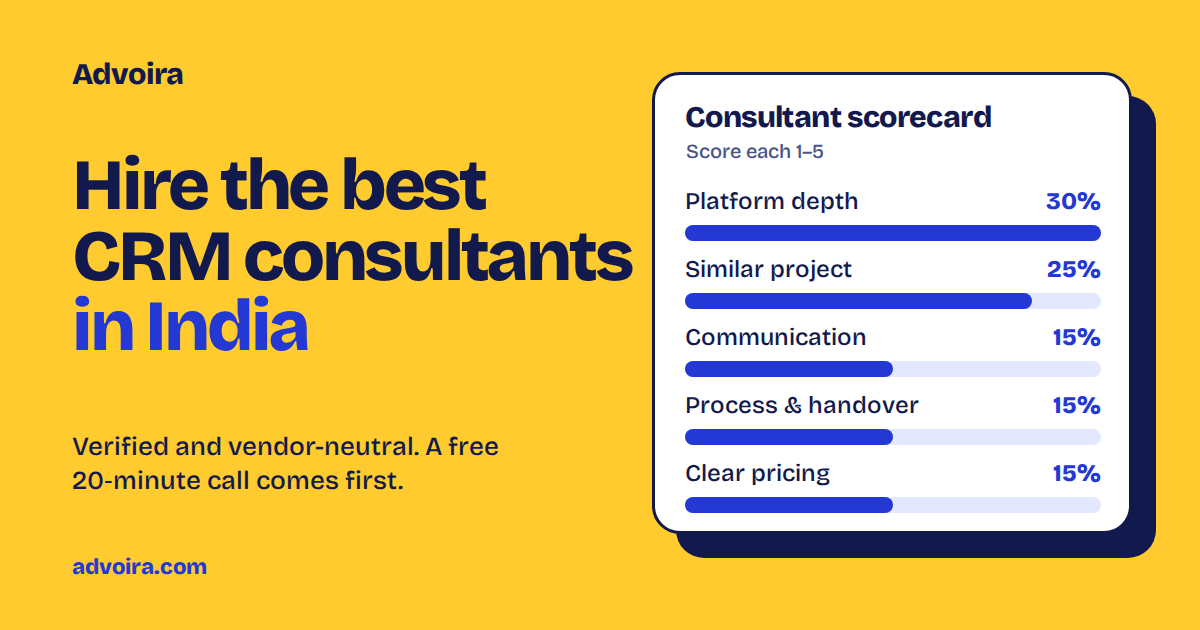
Before you speak to anyone, copy this table. Score each consultant from 1 to 5 on each row after the call, multiply by the weight, and add it up. It won’t make the decision for you, but it stops the most charming person winning by default.
Criteria | Weight | What a 5 looks like |
|---|---|---|
Depth on your platform | 30% | Daily hands-on work on your CRM, can talk about edge cases |
A similar project | 25% | Describes a project like yours, with what went wrong as well as right |
Communication | 15% | Asks questions first, explains without jargon |
Process and documentation | 15% | Clear phases, tests before go-live, written handover |
Commercial clarity | 15% | Written scope, what’s excluded stated up front, no pressure |
Adjust the weights if you like. If your biggest risk is data migration, give a similar project more weight. If your team resists new tools, give communication and training more.
How to Run the Discovery Call
Twenty minutes is enough if you come prepared. Say what you do, what’s broken, and what “better” would look like. Then ask:
- Which platforms do you work on day to day?
- Tell me about a recent project like mine. What went wrong, and how did you handle it?
- What would you want to understand before recommending anything?
- What would you leave out of my first phase?
- Who does the work: you, or a team?
- How do you handle data migration and backups?
- What do you need from my team, and how many hours a week?
- How do you train people and hand over?
- How do you bill, and what’s not in the quote?
- What happens if something breaks after go-live?
- Who owns the scripts, workflows and documentation at the end?
- Can I speak to a past client?
Here is what to listen for:
Question | A good answer sounds like | A weak answer sounds like |
|---|---|---|
What would you leave out of phase one? | “I’d hold off on reports until your data is clean.” | “We can do everything at once.” |
What went wrong on a past project? | A specific story and what they changed | “Nothing, our clients love us.” |
Which CRM should I use? | “Tell me how you sell first.” | A product name in the first two minutes |
What’s excluded from the quote? | A clear list | “Nothing, it’s all-inclusive.” |
The free call is the whole point of Advoira’s model. You find out how someone thinks before any money moves.
What Does a CRM Consultant Cost in India?
Any single number you read online is a guess. Rates depend on seniority, platform, the size of the project and whether you’re hiring a freelancer, an independent consultant or an agency. As a rough reference point from agency listings, Clutch’s India CRM list showed hourly bands from under $25 to $200–300, so a wide spread is normal.
What’s more useful than a rate is knowing how people charge:
- Hourly. Good for small fixes and work where the scope isn’t clear yet.
- Fixed project fee. Good for implementations, migrations and integrations with a clear brief.
- Monthly retainer. Good for ongoing admin, reporting and improvements.
And what moves the price:
- Number of users and teams involved
- How much custom work versus standard setup
- How messy your existing data is
- Number of integrations
- Whether training and documentation are included
When you compare quotes, make sure they cover the same things. Two quotes that look 40% apart can describe different projects. Ask each consultant to confirm in writing whether migration, integrations, training, documentation and post-launch support are included. A very low quote often means one of those has been left out. It tends to come back later as an extra invoice.
For more on this, see CRM Consultant India: What They Do, What It Costs, and Whether You Need One.
Which Platform? A Quick Orientation
If you haven’t chosen a CRM yet, hire for advice first and implementation second. The same person who sets it up shouldn’t necessarily be the one deciding which one to buy. Here’s a rough orientation:
Platform | Often a fit for | Worth asking a consultant |
|---|---|---|
Zoho CRM / Zoho One | Small and mid-size teams that want flexibility and a broad app suite | How will you connect Zoho Books, Desk and Campaigns? |
HubSpot | Teams that value ease of use and tight sales and marketing alignment | Which hubs do we really need, and which tier? |
Salesforce | Larger or more complex organisations | Admin, custom development, and who maintains it later |
Microsoft Dynamics 365 | Businesses already built around Microsoft tools | How it fits with Microsoft 365 and Power Platform |
Odoo | Companies that want CRM and ERP in one system | Which modules, and how much customisation |
SAP | Larger enterprises with complex operations | Implementation partner experience and support model |
This is a starting point, not a verdict. Features and pricing change, so check current details before deciding. If you’re torn, a call with an independent advisor is cheaper than a wrong choice. Our CRM selection advisory page explains how that works.
Mistakes That Waste Money (and How to Avoid Them)
Buying the software before defining the process. If nobody has written down how a lead becomes a customer, the CRM just copies the confusion. Spend an hour on one page first: where leads come from, what happens next, who owns each step.
Hiring on price alone. The cheapest quote often leaves out migration, training or documentation. Compare scope before you compare price.
Importing messy data. Duplicate contacts, mixed spellings and notes crammed into one cell make the new system untrustworthy from day one. Clean first, import second, and test a small sample before the full migration.
No internal owner. Someone on your side has to make decisions fast and care about adoption. Without that person, projects drift.
Skipping training. A short, role-based session built around people’s daily work beats a long generic one. Adoption is where most of the value is won or lost.
Red Flags When Hiring a CRM Consultant
- They recommend a product before asking about your business
- No recent work, case studies or a reference you can speak to
- A vague scope, such as “we’ll figure it out as we go”
- A price far below every other quote, with no explanation
- They only ever recommend one platform
- No plan for training or handover
- They don’t want to talk before you commit
If two or more of these show up, walk away.
Do You Need Someone in Your City?
Usually, no. Most CRM work happens over video, with screen sharing and access to your system. A consultant doesn’t need to sit in Ahmedabad, Mumbai, Bengaluru, Delhi NCR, Pune or Hyderabad to do good work for you in any of them. Filter by skill, platform and industry first, and treat location as a tiebreaker.
If you want someone in your time zone or who works in your team’s language, say so on the call. For more on working remotely, see Hire CRM Consultants Online.
How Hiring Works on Advoira
Advoira is an independent platform for finding CRM and ERP consultants. It isn’t a bidding site, and it isn’t tied to any software company. Here’s the process (full details here):
- Search and filter. Choose your software, service, industry and budget in Find Consultants.
- Read the profile. You’ll see a summary, industries served, project types and rate.
- Book a free 20-minute discovery call. Every consultant listed offers one.
- Decide, then hire directly. You agree scope, price and timeline with the consultant yourself.
A few things worth knowing before you start:
- Vendor-neutral. Advoira doesn’t take referral fees from software companies, so advice isn’t shaped by who pays.
- Manually reviewed profiles. The team reviews each profile before it goes live. Consultants are responsible for the accuracy of their own profiles, and certifications aren’t independently verified, so ask to see proof on your call.
- No account needed to browse. You only share your details when you book a call.
Not sure whether you need a CRM, an ERP, or just a better setup of what you have? Use the Expert Match form on the homepage and we’ll point you towards consultants who specialise in advisory.
Browse verified CRM consultants in India →
Are you a CRM or ERP consultant? You can apply to join Advoira.
Frequently Asked Questions
Who is the best CRM consultant in India? There isn’t one. The best consultant is the one who knows your platform, has done a similar project, and explains things clearly. Shortlist two or three, speak to each, and compare them on the same scorecard.
How much do CRM consultants charge in India? It varies widely with experience, platform and scope. Agency listings on directories such as Clutch show hourly bands from under $25 to $200–300. Freelancers and independent consultants often price differently, so always ask for a written quote for a defined scope.
Which CRM is best for a small business in India? That depends on how you sell, how many people will use it and your budget. Zoho CRM and HubSpot are popular starting points for small teams, but the right answer comes from your process. An independent advisory call can help you choose before you spend.
Should I hire a freelancer or an agency? A freelancer or independent consultant suits small and mid-size projects and direct, hands-on work. An agency suits larger projects that need a team. Many businesses start with an independent consultant for advice and scoping.
How long does a CRM implementation take? It depends on the size of your team, how many integrations you need and how clean your data is. A basic setup for a small team can take a few weeks. A multi-department rollout with migration and integrations can take a few months. A good consultant will give you a phased timeline in writing.
Can the same consultant help with ERP? Some do, particularly on platforms like Odoo and SAP. Others specialise only in CRM. Ask which they do hands-on, and see ERP advisory if you’re weighing both.
How do I check a consultant’s certifications? Ask for a public profile link from the platform vendor, such as Zoho, HubSpot, Salesforce or Microsoft. Then ask them to describe a recent project that used those skills.
What’s the difference between a CRM consultant and an implementation partner? A consultant mainly advises on process and platform choice. An implementation partner is usually a firm that delivers the full build, including configuration, development, migration and training. Some consultants do both.
Is it free to talk to a consultant on Advoira? Yes. Every consultant listed offers a free 20-minute discovery call, and you don’t need an account to browse.